Abstract
Vision-language-action (VLA) models map visual observations and natural-language instructions to robotic actions, but distribution shifts can compromise their reliability. Because these models may still succeed under out-of-distribution (OOD) conditions, detecting OOD inputs alone is insufficient to predict execution failure. In this paper, we introduce VLA-Scope, a two-stage framework that combines input-shift characterization with execution history to predict failure during OOD rollouts. The first stage uses pooled image and language representations to detect OOD inputs and classify their shift categories. For inputs flagged as OOD, the second stage combines the predicted category, action-prefix features, and execution progress features. A logistic regression model shared across shift categories updates failure risk as execution proceeds. We evaluate the framework with OpenVLA on ten LIBERO-Spatial tasks using leave-one-group-out cross-validation. OOD detection achieves a ROC-AUC of 0.9454, and shift classification achieves 91% accuracy. Evaluated independently of the OOD gate on all 1,400 OOD rollouts, the failure predictor achieves a ROC-AUC of 0.8497 after 60 executed actions, compared with 0.7906 without execution progress features. It also achieves higher ROC-AUC than the evaluated ActProbe and SAFE-MLP baselines. These results suggest that combining action features with temporally aggregated execution-step representations improves failure prediction under input shifts.
OOD Does Not Imply Failure
Across the seven evaluated OOD categories, observed failure rates range from 27.5% for Layout to 77.5% for Camera. Every category contains both successful and failed executions. The shift category provides useful context, but execution evidence is needed to predict an individual rollout's outcome.
Shift type provides context for failure prediction. VLA-Scope passes the predicted OOD category to the risk predictor alongside execution evidence. In the action/type ablation at 60 actions, adding predicted type improves ROC-AUC from 0.7756 to 0.7906 over actions alone.
VLA-Scope: From Input Shifts to Failure Risk
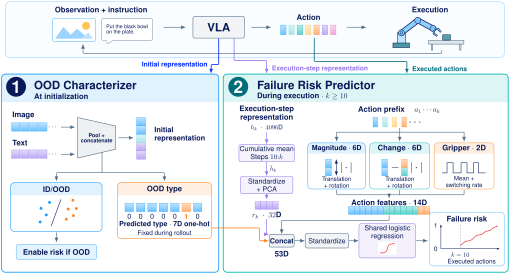
The framework has two stages:
- OOD Characterizer. At initialization, pooled image and language representations are used for ID/OOD detection and OOD type classification. The predicted category remains fixed within a rollout.
- Failure Risk Predictor. During execution, 14 action-prefix features, a seven-dimensional predicted-type encoding, and a 32-dimensional cumulative representation are combined into a shared logistic regression model. Risk is updated from action 10 onward using only the available execution history.
Risk is assessed while execution is still in progress. At each scoring step, VLA-Scope combines the actions executed so far with representations of the observations and instruction accumulated from step 10. It predicts the eventual outcome from this partial history, without waiting for the rollout to finish or using future observations.
The cumulative representation is standardized and compressed with training-fitted PCA before prediction; output scores are not temporally smoothed. Under gated operation, an ID decision returns no failure-risk score; it does not imply task success.
Experiments
We evaluate VLA-Scope with OpenVLA on ten LIBERO-Spatial tasks using Leave-One-Group-Out cross-validation, holding out an entire task in each fold. The evaluation includes 500 ID inputs and 1,400 OOD rollouts across seven shift categories.
How accurately can VLA-Scope characterize input shifts?
| ID/OOD detection | OOD type classification | |||
|---|---|---|---|---|
| ROC-AUC ↑ | TPR (%) ↑ | FPR (%) ↓ | Accuracy (%) ↑ | Macro-F1 ↑ |
| 0.9454 | 84.57 | 6.20 | 91.00 | 0.9123 |
Type classification is evaluated on all OOD cases, independently of the binary gate.
Does accumulating execution evidence improve failure prediction?
Failure-risk ROC-AUC increases from 0.6852 at 10 actions to 0.7675 at 30 actions and 0.8497 at 60 actions. All 1,400 OOD rollouts remain in evaluation at these checkpoints. At later checkpoints, completed rollouts leave evaluation, so the evaluated cohort changes.
| Method | ROC-AUC ↑ | CPU scoring latency ↓ | |
|---|---|---|---|
| 30 actions | 60 actions | 60 actions | |
| ActProbe | 0.7601 | 0.8132 | 1.068 ms |
| SAFE-MLP | 0.7294 | 0.8055 | 3.249 ms |
| SAFE-LSTM | 0.6867 | 0.7414 | 6.773 ms |
| VLA-Scope | 0.7675 | 0.8497 | 0.893 ms |
Failure prediction is evaluated independently of the OOD gate. Neural baseline ROC-AUC is averaged over three seeds. Cached-input latency excludes policy feature acquisition, simulation, file access, and model loading.
What do actions and cumulative representations contribute?
Removing the cumulative representation reduces step-60 ROC-AUC from 0.8497 to 0.7906; removing action features reduces it to 0.8344. Both reduced variants retain predicted OOD type, supporting the complementary value of action features and cumulative representations.
| Predictor input | ROC-AUC ↑ | FPR (%) ↓ | F1 (%) ↑ |
|---|---|---|---|
| Without cumulative representation | 0.7906 | 14.65 | 70.15 |
| Without action features | 0.8344 | 16.64 | 75.36 |
| Full model | 0.8497 | 12.52 | 76.37 |
Success and Failure under Distribution Shifts
Selected paired executions across seven OOD categories show how risk evolves alongside robot behavior. Success and Failure indicate final outcomes. The frame border reflects the current score: green below 50%, red at or above 50%, and gray before scoring begins.
Selected illustrations, not an unbiased sample of performance. Original prediction values are unchanged. Playback: 20 actions/s. The final frame and last eligible score are held after each rollout ends.
BibTeX
@misc{zhu2026vlascopeshiftawarefailureprediction,
  title={VLA-Scope: Shift-Aware Failure Prediction for Vision-Language-Action Models},
  author={Kaiwen Zhu and Dongfang Liu and Liangkai Liu},
  year={2026},
  eprint={2609.21246},
  archivePrefix={arXiv}
}